

What's on the Blog
- How Flexible Labor Keeps Food Logistics Moving
- Why Demand Variability Challenges Food Logistics
- Why Cross-Dock and Last-Mile Operations Must Work Together
- Building a Flexible Food Logistics Workforce
- Why On-Site Leadership Matters
- Measuring Performance Beyond Labor Costs
- Scaling Grocery Delivery Across 18 Centers
- Building a More Responsive Food Logistics Operation
How Flexible Labor Keeps Food Logistics Moving
Food logistics requires more than moving products from a warehouse to a store or a delivery vehicle to a customer’s doorstep. It takes coordinated execution across fulfillment, cross-dock operations, labor, yard management, transportation, and last-mile grocery delivery to keep orders moving and meet customer expectations.
For grocery retailers and food distributors, that coordination becomes more challenging as order volumes fluctuate. Weekday demand may be relatively predictable, while weekends and holidays bring significant surges. E-commerce growth adds another layer of complexity to grocery logistics, requiring operations to fulfill more orders, support additional delivery windows, and maintain consistent service across an expanding network.
On top of this, food logistics companies operate on tight margins. The challenge is finding the right balance between capacity and cost. Staffing for peak demand can leave operations over-resourced during slower periods, while maintaining lean staffing levels can create bottlenecks when volumes climb.
A flexible, integrated workforce model can help food logistics operations respond to changing demand while maintaining throughput, route coverage, and service quality. By connecting cross-dock labor, delivery drivers, yard support, and on-site leadership, companies can build a more responsive operation without relying solely on permanent headcount to absorb every fluctuation.
Why Demand Variability Challenges Food Logistics
Food logistics operations must respond to changing order volumes across multiple time frames. Demand can shift by day of the week, season, geographic market, and individual facility. Even within the same network, one location may experience a surge while another operates at a more typical volume.
E-commerce fulfillment makes this variability particularly visible. As grocery retailers expand online ordering and home delivery, they must coordinate order picking, staging, vehicle availability, driver coverage, and delivery schedules.
A spike in customer orders affects more than the fulfillment team.
- It can increase the workload at cross-dock facilities, create additional demand for delivery vehicles and drivers, and put pressure on the teams responsible for moving orders through the network.
Labor availability adds another challenge.
- Recruiting, training, and retaining enough workers to cover peak periods can be difficult, particularly when the need for additional capacity is temporary or concentrated on specific days.
- Maintaining a workforce large enough to handle the highest possible volume may also create unnecessary labor costs when demand falls.
Food logistics leaders must therefore balance two competing priorities: having enough capacity to handle surges and avoiding excess labor during slower periods.
This starts by understanding how labor requirements change throughout the operation and building the flexibility to respond.
Why Cross-Dock and Last-Mile Operations Must Work Together
Cross-dock and last-mile delivery are closely connected. The efficiency of one directly affects the other, making coordination between teams essential to keeping orders on schedule.
Once customer orders are fulfilled and arrive at a delivery hub, they must move through a series of coordinated steps. Inbound trailers need to be unloaded, orders staged, delivery vans positioned, and vehicles loaded for their assigned routes. Drivers must be available when orders are ready, and vehicles must be moved between docks and staging areas without creating unnecessary delays.
A disruption at any point can affect the entire process.
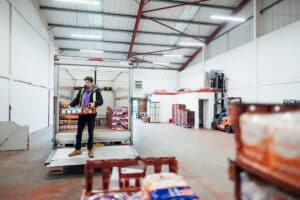
These handoffs become even more important across networks with multiple fulfillment centers, spokes, and delivery routes. Each facility has its own staffing requirements, operating conditions, and demand patterns, so a solution that works at one location may not be appropriate for another.
An integrated operating model helps connect these activities. When cross-dock teams, yard support personnel, and delivery drivers work within a coordinated plan, companies can better align labor with the flow of orders. The objective is to keep products moving through each stage so grocery delivery services stay on schedule.
Every handoff affects the next
Building a Flexible Food Logistics Workforce
Traditional staffing models struggle to accommodate significant changes in daily demand.
Staffing to peak volume may provide enough capacity during holidays and busy weekends, but it can leave facilities carrying excess labor during slower periods. Staffing to average volume creates the opposite risk: when demand exceeds expectations, dock operations may fall behind, routes may go uncovered, and existing employees may be stretched to keep up.
Flexible labor offers another approach. Instead of treating workforce requirements as fixed, operations can adjust staffing levels to reflect actual demand and site-specific needs.
A scalable logistics workforce can provide several advantages:
-
Adjust capacity as demand changes.
Flexible staffing allows operations to increase labor and driver coverage during high-volume periods and scale back when demand declines. This is particularly useful when order patterns vary significantly between weekdays and weekends or when seasonal demand requires additional resources for a limited period. -
Connect dock and delivery responsibilities.
Cross-training can help employees support more than one part of the operation. In an integrated model, some workers may handle both dock and delivery responsibilities, helping maintain continuity between order staging and final delivery. This approach can also give site leaders more options for deploying available labor as conditions change. -
Support network expansion.
As grocery retailers add fulfillment locations, delivery routes, and customer time slots, labor needs can grow quickly. A workforce model designed to scale can help operations add capacity without requiring every location to build its own permanent staffing base before demand is established. -
Protect service capacity.
Flexibility is most valuable when it helps operations meet customer commitments. With the right labor and driver coverage, retailers can support additional delivery opportunities while reducing the risk that volume increases will overwhelm existing teams.
The key is to align flexibility with operational requirements. Labor must be available where and when it is needed, with the training, coordination, and accountability required to support consistent execution.
Why On-Site Leadership Matters
A flexible workforce is only part of the solution. Without effective coordination, adding labor or drivers may not resolve the bottlenecks affecting performance.
On-site leadership helps connect staffing decisions with the realities of daily operations. Supervisors who work directly within a facility can coordinate with site managers, monitor workflow, identify developing problems, and redirect resources as conditions change.
That coordination may include confirming that routes are covered, ensuring vans are moved to the appropriate staging areas, monitoring dock throughput, and addressing delays that could affect delivery schedules. It also creates a direct communication channel between the workforce partner and facility leadership.
This is especially important across multi-site networks. A centralized staffing plan provides a starting point, but local leaders need the ability to respond to changing conditions at individual facilities. A sudden increase in orders, a change in route requirements, or a labor gap at one location may require immediate adjustments.
Embedded supervisors can help identify these issues early and coordinate a response before a localized problem affects the broader operation.
Leadership also supports accountability. When teams have clear expectations for productivity, safety, route readiness, and customer service, managers can evaluate performance and identify opportunities for improvement.
For food logistics operations, the combination of scalable labor and hands-on site leadership creates a stronger foundation for managing variability. The workforce can expand or contract as needed, while local oversight helps ensure that the additional capacity translates into operational results.
Measuring Performance Beyond Labor Costs
Labor flexibility should be evaluated by more than the number of workers scheduled or the hourly cost of staffing.
In food logistics, workforce decisions affect multiple operational outcomes. An approach that reduces labor expense but creates delays in cross-dock processing or leaves delivery routes uncovered may undermine the broader goals of the operation.
Performance measures should reflect how effectively labor supports the entire flow of orders. Depending on the operation, relevant measures may include:
- ✓ Route coverage: Whether sufficient drivers are available to support planned delivery schedules.
- ✓ Productivity: How effectively labor and other resources support daily operating requirements.
- ✓ On-time delivery: Whether orders reach customers within their expected delivery windows.
- ✓ Safety: Whether work is performed consistently with established safety expectations.
- ✓ Throughput: How efficiently orders move through unloading, staging, and vehicle loading.
- ✓ Customer satisfaction: Whether service quality meets the retailer’s expectations and customer commitments.
These measures help connect workforce decisions to business outcomes. They also give operations leaders a clearer way to identify bottlenecks, assess performance across locations, and determine where changes in staffing or workflow may be needed.
A performance-driven model can further reinforce accountability by tying operational execution to defined expectations and measurable results. Rather than viewing labor as a standalone expense, companies can evaluate how effectively their workforce supports the performance of the overall logistics network.
Scaling Grocery Delivery Across 18 Centers

The retailer needed a partner that could provide dependable drivers and dock labor, respond quickly to changing needs, and maintain high customer service standards across a growing fulfillment network.
Capstone Logistics began supporting the operation in December 2023 with a small fleet of trained drivers for holiday demand. The initial engagement expanded into a long-term partnership that now supports home delivery, cross-dock operations, and yard marshalling across 18 e-commerce centers.
The program grew from six drivers to more than 750 drivers in 18 months. Capstone also provides dockworkers and cross-trained employees who can support both dock and delivery responsibilities, helping coordinate the movement of orders from fulfillment facilities to customers.
Local Capstone leadership teams work directly with facility managers to coordinate staffing, route coverage, vehicle movement, and dock throughput. The operating model allows the retailer to adjust coverage in response to changing daily demand, including expanding support during busy weekends and reducing capacity during slower midweek periods.
The results demonstrate the potential of a coordinated, scalable approach to food logistics:
- 34,000+ weekly deliveries supported across the network.
- 18 e-commerce centers receiving operational support.
- 1,700+ average weekly routes supported.
- 750+ drivers supporting the delivery operation.
- 72-hour initial response time to mobilize support.
The partnership has also helped the retailer improve on-time delivery performance and throughput efficiency while consistently exceeding its customer service benchmarks, according to the case study.
While every food logistics network has different operating requirements, this example illustrates how flexible labor, integrated cross-dock and driver services, and embedded leadership can help organizations respond to growth without sacrificing service quality.
Building a More Responsive Food Logistics Operation
Demand variability is a fundamental planning challenge for grocery retailers and food distributors. The goal is not simply to have more labor available during peak periods. It is to coordinate the right resources across fulfillment, cross-dock operations, yard management, and last-mile delivery so that orders continue moving efficiently as conditions change.
A flexible workforce can help organizations match capacity to demand. Cross-trained employees can support connected responsibilities, while on-site leadership helps coordinate execution and resolve operational bottlenecks. When these capabilities are supported by clear performance expectations, companies can make more informed decisions about staffing, productivity, and service quality.
For organizations looking to scale grocery logistics and last-mile food delivery, the right operating model can provide the flexibility to accommodate growth while maintaining customer commitments.
Capstone Logistics provides scalable cross-dock labor, trained delivery drivers, yard support, and embedded operational leadership to help food logistics networks respond to changing demand. By connecting workforce capacity with day-to-day operational needs, Capstone helps grocery retailers and food distributors keep orders moving from fulfillment center to customer door.
Operational variability does not have to limit growth or customer service.
Contact Capstone Logistics to discuss how a flexible, integrated workforce model can support your food logistics operation.
Related Blogs


Reach Out Today for a FREE Assessment
Utilize a modernized labor solution that pushes your business forward instead of holding it back. Reach out today for a FREE Assessment of your operations!