How Logistics Companies Power Modern Supply Chains
Global supply chains have become significantly more complex over the past two decades. Companies today rely on logistics companies and third-party logistics (3PL) providers to manage warehousing, inbound logistics, inventory management, and transportation across their networks.
| Model | Role in Supply Chain | Typical Services |
|---|---|---|
| 3PL (Third-Party Logistics) | Executes logistics operations | Warehousing, transportation, order fulfillment, inventory management |
| 4PL (Fourth-Party Logistics) | Coordinates logistics providers | Supply chain strategy, vendor management, network optimization |
| 5PL (Fifth-Party Logistics) | Manages entire supply networks | Technology-driven optimization, digital logistics platforms |
What is third-party logistics (3PL)?
Third-party logistics providers support companies by managing specific logistics functions. These services typically include warehousing, transportation, order fulfillment, inventory management, and value-added services such as packaging or kitting. Many companies turn to 3PL providers to handle the operational side of moving and storing goods while internal teams focus on core business activities.
A 3PL often operates as an extension of a company’s logistics department. Businesses retain control over overall supply chain strategy, while the 3PL executes day-to-day logistics operations. This model is widely used across industries because it allows organizations to scale logistics operations without investing heavily in physical infrastructure such as warehouses, equipment, and transportation fleets.
Common services offered by 3PL providers include warehousing and distribution, transportation management, freight forwarding, inventory management, and order fulfillment. By outsourcing these activities, organizations gain access to logistics expertise, established transportation networks, and operational efficiency that may be difficult to replicate internally.
What is fourth-party logistics (4PL)?
Fourth-party logistics providers operate at a higher level of supply chain coordination. A 4PL manages and integrates multiple logistics providers and partners across the supply chain, serving as a single point of contact for logistics strategy, planning, and execution.
Instead of focusing on individual logistics tasks, a 4PL oversees the entire logistics ecosystem. This includes coordinating multiple 3PL providers, carriers, and technology systems to optimize performance across the supply chain. In many cases, 4PL providers focus on strategic management and data integration rather than operating physical assets such as warehouses or trucks.
Organizations that use a 4PL model often seek greater visibility and alignment across complex supply networks. The provider may handle activities such as supply chain design, demand planning, network optimization, vendor management, and performance analytics. This approach centralizes logistics management while leveraging multiple specialized service providers.
What is fifth-party logistics (5PL)?
Fifth-party logistics represents a newer stage in the evolution of logistics outsourcing. A 5PL provider focuses on managing entire supply networks and coordinating multiple supply chains simultaneously. These providers use advanced technologies and data platforms to optimize logistics performance across large ecosystems.
The 5PL model often incorporates technologies such as artificial intelligence, big data analytics, Internet of Things (IoT) devices, and automation to improve supply chain visibility and decision-making. These capabilities allow companies to coordinate complex logistics networks that involve numerous partners, distribution channels, and customer markets.
This model is particularly relevant in industries such as e-commerce, where large volumes of orders, global supplier networks, and rapid delivery expectations require advanced coordination and digital infrastructure. A 5PL provider may simultaneously manage multiple 3PL and 4PL relationships while optimizing supply chain performance through technology-driven insights.
How these logistics models compare
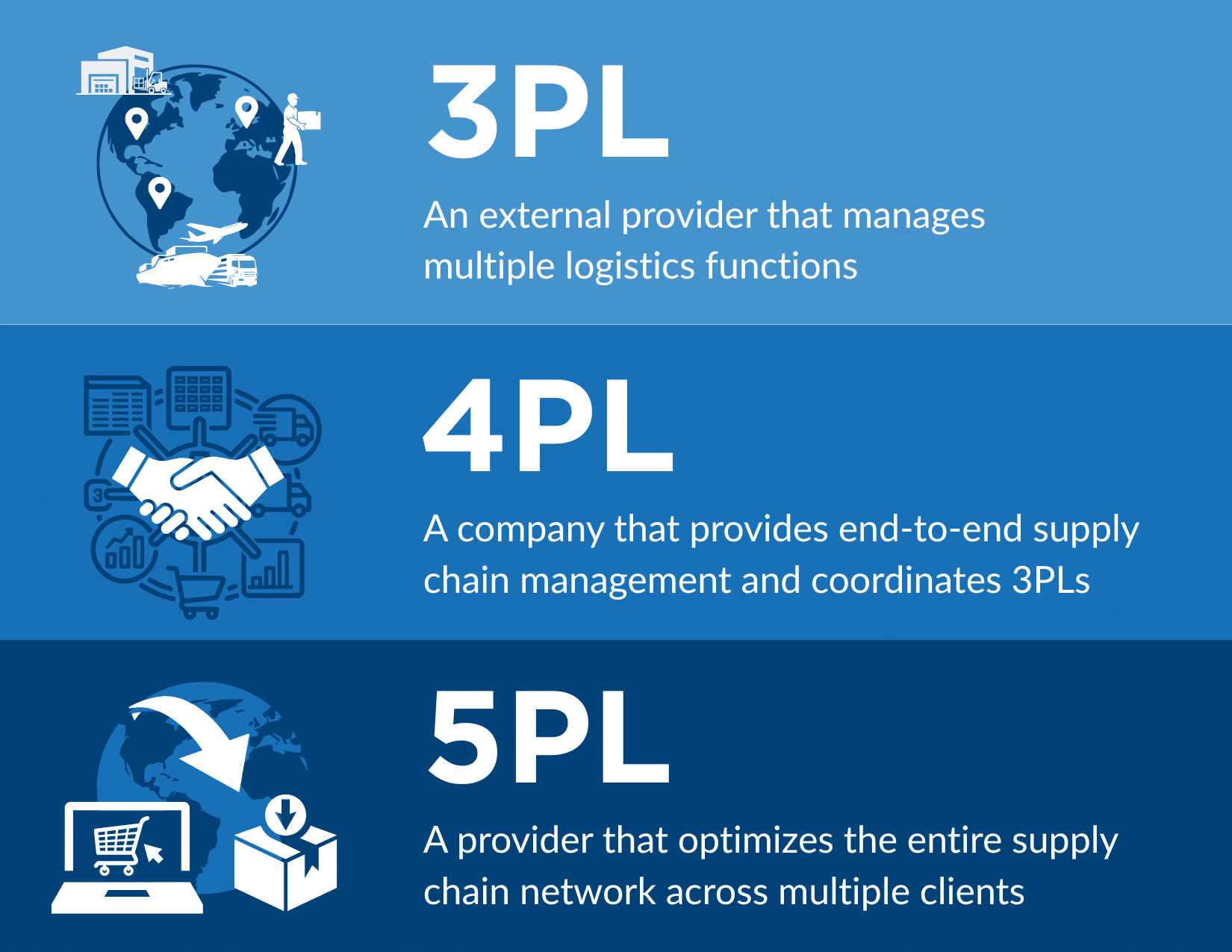
The differences between 3PL, 4PL, and 5PL generally come down to scope and responsibility within the supply chain.
A 3PL focuses on executing logistics operations such as storage, fulfillment, and transportation. A 4PL manages the broader logistics strategy and coordinates multiple service providers across the supply chain. A 5PL expands that coordination to entire supply networks and uses advanced digital technologies to optimize performance across multiple supply chains.
Each model serves different organizational needs. Companies with straightforward logistics requirements may rely on a 3PL for operational support. Organizations managing complex supply chains across multiple partners may benefit from a 4PL approach. Businesses operating large-scale or highly digital supply networks may look toward 5PL solutions to integrate technology, analytics, and network-level coordination.
When Companies Use a 3PL Logistics Provider
Companies typically partner with a 3PL logistics company when they need support with operational execution such as warehousing, transportation, and inventory management.

Common reasons organizations use 3PL providers include:
- Scaling warehouse operations without investing in facilities
- Improving inventory management and inbound logistics
- Expanding transportation capacity
- Increasing operational efficiency across distribution networks