

What MODEX 2026 Told Us About the Future of Logistics (And What It Didn’t)

MODEX 2026 did not lack for ambition. Across the show floor, humanoid robots, smart conveyors, and drones whizzing through giant racks of inventory vied for attention. In session rooms, the conversation was dominated by automation, AI, and data collection — technologies and challenges that are reshaping how supply chains operate. But perhaps the most consistent message from the speakers and practitioners we heard wasn’t about what’s coming. It was about what to do right now, while the future takes its time arriving.
Capstone attended several sessions and held several meetings and conversations across the four-day event in Atlanta. Here’s our MODEX 2026 recap — our key takeaways: not a technology wish list (though we wouldn’t mind a Spot®), but a practical read on the decisions supply chain leaders are making today.
1. Data Without Purpose Is Overhead
Start here, because every other conversation at MODEX eventually came back to this: it doesn’t matter how much data you have if your organization doesn’t trust it or act on it.
One of the more thought-provoking sessions we attended covered a major company’s process mining initiative. The core finding is pretty shocking: nearly half of the operational inefficiencies the business uncovered were caused by manual interventions — people overriding system decisions because they didn’t trust the data.
That’s a problem. Organizations invest in WMS platforms, tracking tools, and analytics dashboards … and then watch floor managers route around them based on intuition. The issue isn’t always bad data. It’s often a trust gap between the people generating the data and the people the data is supposed to guide.
The solution this organization found wasn’t top-down enforcement. It was inclusion: bringing floor-level subject matter experts into the process redesign. When the people doing the work help build the processes, adoption follows.
Another session presenter made the same point from a labor angle: synthetic models can provide useful industry baselines, but real-world conditions in your specific facility will diverge from benchmarks. The data has to be yours — grounded in your actual operations — and you have to be willing to act on what it tells you, even when it conflicts with instinct.
The Practical Framework for Automation
The operations that struggle with automation are not the ones that move slowly. They’re the ones that skip these steps.
- Evaluate before you change anything
- Implement in phases that protect current throughput
- Establish KPIs before go-live
- Treat maintenance as a first-class operational function, not an afterthought
2. Automation Is Real, but How You Implement Matters Most
The automation conversation at MODEX has matured. Nobody was selling “lights-out warehouses” as a near-term reality. The more credible message — reinforced across multiple conversations — was that full automation is a 2030-and-beyond story for most operations. The pressing question is what to do between now and then.
First-stage automation is the wisest course forward for most businesses, using semi-automation as a practical bridge: conveyor systems, sortation, operator-assist tools, and other technologies that deliver measurable ROI without requiring a complete operational overhaul. The principle we heard repeatedly was the Pareto approach: identify the highest-leverage processes, automate those first, and iterate.
The advice was consistent across sessions: start small, build on reliable data, and phase implementation so it doesn’t disrupt current operations. Agile methodology — evaluate, implement, scale — was cited explicitly as the right framework. The worst outcome isn’t moving slowly; it’s making a large capital commitment without the infrastructure to support it.
And, while automation can help relieve the burden on manual labor, even advanced robotic systems will require conveyor interfaces and semi-automated staging for the foreseeable future. Automation raises the stakes for good process design. It doesn’t eliminate it.
3. The Labor Crisis Is Not a Future Problem
Warehouse jobs aren’t getting filled. There are more warehouse jobs listed than people actively seeking warehouse employment, driving an ongoing labor crisis for warehouses, distributors, and manufacturers. Geography is a major factor: workers don’t necessarily live near the facilities that need them, and competing wages at jobs closer to home or with fewer barriers to entry continue to erode the labor pool.
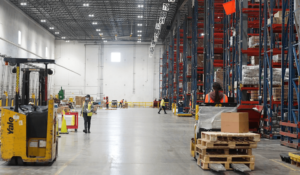
What does viable look like in practice? A presenter during one of the sessions at MODEX laid out a framework that Capstone operators will recognize — establish a baseline, then improve systematically through layout optimization, technology, training, and process improvement. Among their most pointed observations: organizations that rely heavily on quantitative KPIs without understanding the qualitative picture beneath them often miss the real cost drivers. Travel is the number-one cost in most warehouse operations. Overtime running above 3–4% signals underutilization of the base workforce. Onboarding costs are consistently underestimated.
The practical implication is that, while automation catches up with the labor market, operations need to be structured, tracked, and incentivized correctly. Good jobs, proper training, and strong safety standards aren’t just good HR practice; they’re retention tools in a market where every warehouse worker has options. Partnering with a 3PL that prioritizes employee performance and retention has never been more important.
4. When Choosing a 3PL, Focus on Finding a Partner, Not a Provider
The mechanics of running an RFP — how to structure bid packages, evaluate responses, and negotiate contracts — came up in several conversations, especially around what actually determines whether a 3PL relationship succeeds or fails.
According to industry consultants at MODEX, the answer is alignment, not pricing. Shippers that enter a 3PL relationship focused primarily on cost often find themselves managing a contract rather than a partnership, and those relationships tend to erode under the pressure of operational complexity.
The practical advice was pointed: don’t confuse a bid with a deal. Use a budget-based pricing approach to build structure, then migrate to the right model — fixed, variable, or hybrid — based on operational reality. Give bidders enough time to respond meaningfully (four weeks minimum for an RFP response; five to six months for full negotiation). Manage to the contract as a living document, not a shelf artifact.
Also notable: significant volumes of warehouse space are sitting empty due to volatile market conditions. This is leading to a rise in short-term, cost-plus leases, as building owners or service providers look to consolidate multiple contracts into empty spaces. That context matters when evaluating whether to insource, outsource, or restructure an existing 3PL network.
The bottom line is one Capstone has operated by for four decades: shared goals and honest communication between shipper and operator are what produce durable results. While that’s harder to evaluate in an RFP than a price per pallet, it’s the right thing to evaluate.
5. The Human Role Is Evolving, Not Disappearing (Yet)
If there was a single counternarrative running through MODEX 2026, it was this: automation does not reduce the need for skilled logistics professionals. It changes what they do.
It was a common refrain out on the floor, made by people impressed with the bleeding-edge technology on display: “We’re out of a job soon.” Yet, every automation session eventually arrived at the same constraint: automation performs reliably on repeatable, standardized tasks. It struggles with variability — unusual packaging, non-standard SKUs, shifted pallets, dynamic prioritization decisions. In those areas, human judgment remains irreplaceable, and likely will be for a long time.

Look at unloading to see this in action. Semi-automated unloading equipment improves throughput rates two to three times faster than a two-person manual crew and reduces physical strain significantly, particularly in the low-lift motions that drive most unloading injuries. But it still requires an operator to feed the system, monitor performance, and intervene when freight doesn’t conform. The automation helps operators work more effectively, and can reduce reliance on manual labor, but it doesn’t replace them.
The emerging challenge becomes one of precision: as automation increases, the biggest productivity bottleneck becomes the people interfacing with automated systems. Reallocation based on real-time productivity data — knowing where human attention is most needed and deploying accordingly — becomes the central management skill.
What that requires is experienced logistics operators who can recognize which data are relevant, make decisions, and manage complex environments. The skills gap in logistics isn’t only about automation training. It’s about developing the judgment to lead operations that blend human and automated workforces effectively.

The Through-Line: Plan the Interim, Not Just the Destination
The conversations at MODEX 2026 were more grounded than the hype cycle around supply chain technology might suggest. Practitioners are not waiting for fully autonomous warehouses. They are making decisions now — about labor, data infrastructure, automation investment, and 3PL partnerships — that will determine how well they’re positioned when the next wave of technology matures.
The through-line connecting every conversation: get the interim right. Start with honest measurement. Build structured processes. Phase implementation to protect operations in progress. Choose partners whose incentives align with your outcomes. And develop the people who will make sense of all of it.
That’s not a new insight; but hearing it reinforced by practitioners at the world’s largest supply chain event suggests it bears repeating.
>> Capstone Logistics operates across 700+ locations nationwide, managing warehouse operations for some of the largest supply chains in the country. Our pay-for-performance model ensures our outcomes are directly tied to yours. Learn More