
When the Work Comes Home: Nearshoring’s Impact on Kitting, Co-Packing, and Domestic Labor
Supply chain conversations over the past year have centered on tariffs, trade policy, and sourcing strategy, as companies across manufacturing, retail, automotive, and consumer goods sectors are reevaluate where products are made. Nearshoring and reshoring initiatives continue to gain momentum as organizations look to reduce financial burdens and gain greater control over their supply chains.
What receives far less attention is what happens after that decision is made.
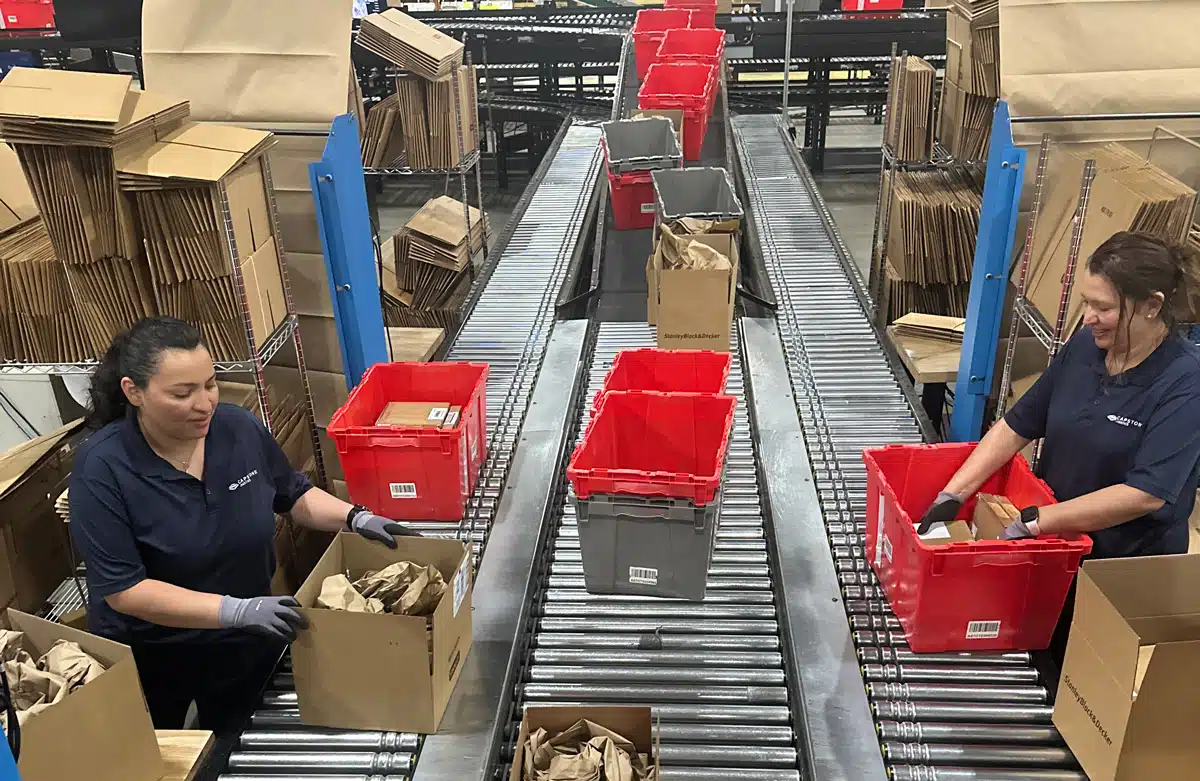
When production moves closer to home, a significant amount of finishing work moves with it. Kitting, co-packing, display assembly, customization, labeling, and light assembly work that was once completed overseas becomes a domestic operation the moment production moves closer to home. While executives often focus on transportation savings, inventory strategy, or tariff exposure, the success of many reshoring initiatives ultimately comes down to a different question:
Who is going to do the work?
The real challenge of reshoring is determining how to execute and scale specialized finishing work in an already constrained labor market.
Reshoring Extends Beyond Manufacturing
The traditional reshoring discussion focuses on factories, production lines, and sourcing footprints, but manufacturing is only one piece of the picture.
Finished goods frequently require additional handling before reaching a retailer or distributor. Products may need to be bundled into variety packs, assembled into promotional displays, customized for specific retailers, relabeled for different channels, or packaged for e-commerce fulfillment.
Historically, much of that finishing work occurred near overseas manufacturing sites. As production moves closer to North American markets, these value-added warehousing services are moving with it, creating a growing need for domestic operational capabilities that can support production-adjacent work without sacrificing speed, quality, or cost.
Why Kitting and Co-Packing Are Becoming Strategic Capabilities
Consumer demand is shifting faster and becoming harder to predict. To keep pace, retailers are looking to distributors for rapid responses to promotions, seasonal programs, and channel-specific requirements. E-commerce growth continues to create unique packaging and fulfillment needs. Manufacturers are also under pressure to reduce inventory exposure while maintaining flexibility.
These trends all elevate the importance of postponement strategies, where products are configured, assembled, or customized closer to the point of demand. Organizations can create retailer-specific displays, assemble variety packs, execute promotional packaging programs, and support specialized fulfillment requirements without carrying excess finished-goods inventory.
Manufacturing kitting and domestic co-packing operations support this flexibility by allowing companies to delay final product configuration until demand signals become clearer. Done well, they deliver:
- Greater responsiveness to changing demand
- Reduced inventory risk
- Faster execution of promotional programs
- Improved retailer compliance
- Better support for e-commerce and omnichannel fulfillment
- Increased supply chain agility
As nearshoring and reshoring accelerate, these capabilities are becoming a critical extension of the manufacturing process rather than an isolated warehouse function.

Built on Pay-for-Performance
Tying performance-based incentives to value-added services is a win-win for everyone. For one partner, using Pay-for-Performance in kitting services meant that cost-per-case went down while throughput went up — all with zero safety incidents and a 25% increase in associate wages. Learn more in our case study:

Domestic Workforce Skills Are Required
Many manufacturers and distribution operations continue to struggle with workforce shortages, turnover, wage pressure, and competition for skilled labor. The addition of new reshored operations only increases demand for workers across warehouse, production, and fulfillment environments.
As more finishing work moves onshore, companies may find themselves competing for the same labor pools needed to support both production and distribution activities.
The challenge is that value-added services are labor-intensive. Companies can invest in facilities, automation, and sourcing strategies, but none of those investments matter if operations cannot be staffed effectively.
For many supply chain leaders, workforce capacity is becoming the factor that determines whether reshoring initiatives achieve their intended outcomes. Questions that were once secondary are now becoming critical to planning discussions:
- How quickly can a new value-added operation be launched?
- Can labor scale to support seasonal peaks and promotional programs?
- How will productivity be maintained as volume increases?
- Can quality standards be preserved across multiple customer programs?
- How can organizations balance labor and automation investments effectively?
The answers determine how quickly companies can realize the benefits of bringing work closer to home.
Why Execution Matters as Much as Strategy
The operational demands of value-added services call for workforce management, process engineering, production visibility, and continuous improvement to work together. Companies need partners that can move beyond simply supplying labor; they need teams who can start operations quickly, integrate with existing production environments, support automation investments, and maintain accountability for throughput, quality, safety, and cost.
This has an outsize impact in the early stages of a reshoring initiative, where new manufacturing strategies create immediate demand for kitting, assembly, packaging, and customization capability long before an organization can build it internally.
The ability to rapidly deploy labor, establish repeatable processes, and scale operations becomes a competitive advantage.
Supporting the Next Phase of Reshoring

As reshoring continues to reshape supply chains in 2026 and beyond, companies will increasingly evaluate how work gets done after production is complete.
Capstone’s kitting & co-packing solution was built to support exactly these types of operational requirements. By combining performance-driven labor management, process engineering expertise, automation integration, and scalable workforce deployment, Capstone helps organizations execute value-added services programs inside manufacturing and distribution environments.
Whether supporting variety pack assembly, retail display construction, industrial kitting, e-commerce packaging, or manufacturing-adjacent co-packing, Capstone provides the workforce and operational accountability required to scale quickly while maintaining productivity and cost control.
As more work comes home, the organizations best positioned for success will be those that have a plan not only for where the work will be performed, but also for how it will be staffed, managed, and scaled.
Interested in learning more about bringing your operations home? Capstone excels at improving output in your facilities with our hybrid, performance-first model; we’ve been doing it for over 40 years.