

Automation Alone Won’t Solve Your Labor Problem. Here’s What Will.
Organizations have embraced automation across retail, grocery, consumer packaged goods, and industrial supply chains, investing heavily in robotics, AI-driven systems, automated storage and retrieval systems (AS/RS), autonomous mobile robots (AMRs), and conveyor technologies to improve throughput, reduce costs, and create more resilient operations.
But organizations are not seeing the benefits they expected. While the conversation around automation often focuses on reducing labor dependency, many enterprises are discovering that automation changes labor needs far more than it eliminates them. As automated environments become more complex, companies face new operational problems and challenges tied to workforce specialization, maintenance, supervision, and surge capacity. In extreme cases ROI stalls, rollouts fail, and downtime compounds.
The result is a growing realization: warehouse automation labor strategy is not about replacing people. That won’t solve the problem. It is about building a workforce model where technology and labor work together effectively.
The problem isn’t the technology. It’s that most organizations built an automation strategy without building a workforce strategy to go along with it.
The Automation Promise — And Where It Breaks Down
Automation delivers meaningful value inside warehouse operations. Automated systems can improve pick accuracy, increase throughput, reduce repetitive motion tasks, and help facilities operate more consistently during labor shortages. For organizations with high-volume, repeatable workflows, the benefits can be substantial.
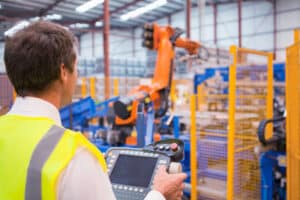
However, automation projects often encounter friction once they move from concept to day-to-day execution. Many warehouses underestimate the operational complexity that comes with automated systems. Equipment downtime, software integration issues, maintenance requirements, and workflow variability can create new bottlenecks that technology alone cannot resolve.
Even highly automated distribution centers still rely heavily on labor for exception handling, replenishment, supervision, quality control, inventory management, dock operations, and system recovery during disruptions.
Automation works best in structured, predictable workflows; but supply chains are rarely fully predictable. Demand spikes, SKU proliferation, seasonal variability, returns processing, and last-minute customer changes still require human adaptability and decision-making.
This is where many “automate everything” strategies lose momentum. Companies invest heavily in technology expecting labor challenges to disappear, only to discover that automation introduces an entirely different category of workforce requirements.
What Automation Actually Solves
Automation remains a critical part of modern warehouse operations. It is highly effective at:
- Reducing repetitive manual tasks
- Increasing throughput consistency
- Improving picking and sorting speed
- Enhancing inventory accuracy
- Supporting labor efficiency in high-volume workflows
- Reducing strain-related injuries in repetitive environments
- Providing operational visibility through integrated systems
In facilities struggling with persistent labor shortages or high turnover, automation can stabilize portions of the operation that are difficult to staff consistently. It can reduce the stress and fatigue from repetitive or physically demanding tasks. It also improves scalability for organizations experiencing rapid growth or peak volume volatility.
But automation is only one piece of warehouse workforce strategy. It does not remove the need for operational expertise, workforce flexibility, or continuity planning.
Protecting Automation Performance at the Source
Capstone’s IQ Program identifies and intercepts non-conforming inventory before it reaches automated systems, preserving the performance your automation investment depends on.
For one of our partners, our program stopped 11,000 defective pallets from reaching the ASRS in the first year, preserving throughput and streamlining compliance without disrupting operations.
The Workforce Gap Automation Creates
As organizations automate more workflows, they often create new labor gaps that are harder to fill than traditional warehouse roles. Automated environments require workers with additional specialized technical knowledge, including:
- Equipment troubleshooting and robotics monitoring
- Conveyor and automation maintenance
- Systems coordination and software/controls support
- Operational oversight and exception management
These roles require different training, different recruiting strategies, and different workforce management models than traditional warehouse staffing.
Automation, by its nature, also reduces flexibility in some circumstances. Human workers can quickly shift priorities during disruptions or volume spikes. Automated systems are typically designed around predefined workflows, making sudden changes more difficult to manage. When systems fail or require maintenance, organizations still need trained personnel who can respond quickly to minimize downtime.
In many facilities, the challenge becomes less about reducing labor and more about securing the right labor.
Why Fully Automated Strategies Often Stall
One of the most persistent misconceptions in supply chain automation is that implementation automatically leads to operational transformation. Many automation projects stall because organizations underestimate the complexity of integrating automation into existing warehouse operations.
Common challenges include
⚠️ Long implementation timelines
⚠️ Integration issues between legacy systems and automation platforms
⚠️ Workforce adoption challenges
⚠️ Insufficient maintenance planning and lack of trained operational support
⚠️ Difficulty scaling during transition periods
⚠️ Unexpected operational disruptions during deployment
What’s At Stake
The automation investment is visible on the balance sheet. The workforce strategy rarely is — until something fails. Organizations that treat labor strategy as a line item to be reduced rather than a capability to be built tend to discover the cost of that mindset at the worst possible moment: mid-implementation, mid-peak, or mid-outage.
The Hybrid Warehouse Model
The most effective warehouse operations are increasingly built around collaboration between automation and labor — not replacement. In a hybrid warehouse model, automation handles highly repetitive, physically demanding, high-volume workflows while human workers focus on areas requiring flexibility, judgment, problem-solving, customization, and operational coordination.
This approach allows organizations to:
✅ Improve productivity without sacrificing adaptability
✅ Reduce repetitive labor strain while maintaining workforce agility
✅ Scale operations more effectively during seasonal surges
✅ Improve continuity during system downtime or disruptions
✅ Maintain operational flexibility across changing customer demands
Human workers remain essential in areas where conditions change rapidly or where workflows are too variable for full automation. At the same time, automation enhances workforce productivity by reducing low-value repetitive tasks and enabling employees to focus on more strategic operational responsibilities.
The future of warehouse operations is not labor versus automation. It is the ability to integrate both effectively.

Supporting Automation Requires Operational Expertise
Most automation support models separate the technology from the workforce: one vendor for training and maintenance, one for temporary labor, and no one accountable for the gap between them. Capstone operates differently.
Across 700+ locations — whether traditional distribution, mid-transition, or highly engineered — our pay-for-performance model holds us accountable for throughput. Our incentive is always to keep your operation moving, whether that requires a maintenance technician, a surge labor deployment, or both.
With 50+ vendor-certified technicians, 15 dedicated automation maintenance sites, and 300+ combined years of team experience, we bring the technical depth to protect your automation investment and the operational scale to support the environments that run alongside it.
Automation alone is not a complete workforce strategy. It never has been. The question is whether your partner is built to close that gap.
Learn more about Capstone’s automation maintenance and workforce capabilities at capstonelogistics.com.